
Introduction
As part of an ongoing experiment. I am using Google Gemini to perform research on different topics. I am finding the process fascinating and dotted with surprising results (e.g., the casual an realistic nature of the chat itself). In an effort to share my experience with other curious minds. I’m publishing some of my findings using this platform. This article was compiled with the help of Google Gemini.
A note of caution: Please perform your own fact check and verification before you put any of the below advise in practice; a list of information sources has been provided at the end of the article. The purpose of this publication is purely to share my experience with Google Gemini as a research tool.
Separating Fact from Fiction: The Truth About Sunlight and Testosterone
In the search for ways to optimize health, improve vitality, and naturally elevate hormone levels, men are frequently bombarded with “biohacking” advice. Some of these trends are grounded in solid physiology, while others are little more than modern myths dressed up in the language of science. Among the more viral—and potentially dangerous—trends to emerge in recent years is the claim that exposing the testicles to direct sunlight or UV radiation can significantly boost testosterone levels.
When a health claim promises a simple, “natural” solution for a common concern like testosterone optimization, it is easy to see why it spreads quickly. However, when it comes to the delicate anatomy of the male reproductive system, the gap between viral misinformation and medical reality is vast.
The Origin of the Myth
The notion that testicular UV exposure is a testosterone-boosting panacea often traces back to a singular, outdated study published in 1939. In this research, a small group of institutionalized men—many of whom were dealing with mental health conditions—were exposed to UV radiation on their genital area. The study reported an increase in urinary androsterone, a metabolite of testosterone.
In the decades since, this research has been almost universally dismissed by the medical community for several reasons: the sample size was incredibly small, the methodology would not meet modern ethical or scientific standards, and the findings have never been replicated in robust, peer-reviewed clinical trials. Despite this, the claim was revitalized in the digital age by health influencers, turning a long-forgotten, flawed study into a viral trend.
The Anatomy of Risk: Why Your Testicles Need Protection
To understand why direct sunlight or tanning bed exposure to the testicles is ill-advised, one must first look at the unique biological purpose of the scrotum.
The testicles are located outside the body cavity specifically to remain at a temperature slightly lower than the core body temperature. This “cool” environment is a strict biological requirement for healthy sperm production (spermatogenesis). Introducing heat—whether through concentrated sunlight, tanning lamps, or even tight clothing—can disrupt this thermal regulation. Studies have shown that localized heat stress can lead to decreased sperm count and motility.
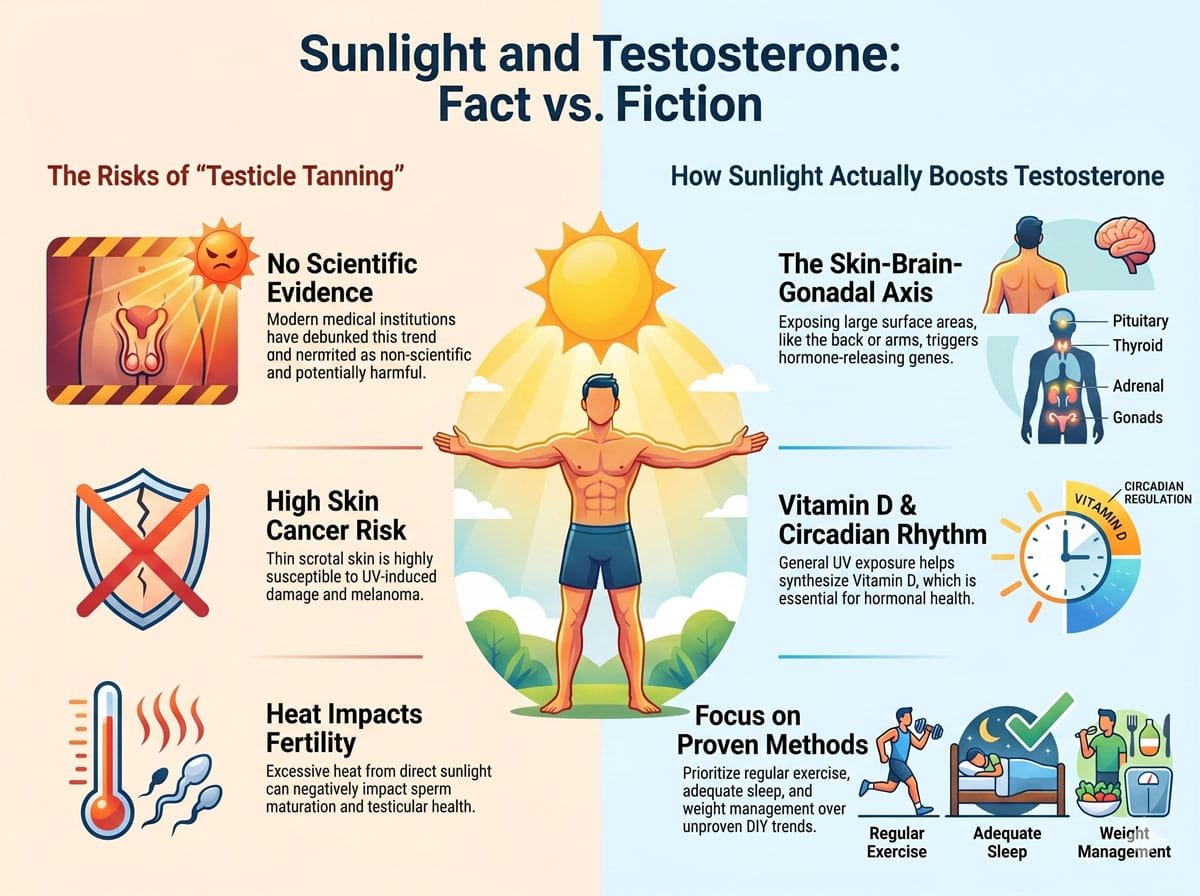
Beyond the issue of temperature, there is the immediate risk of skin damage. The skin of the scrotum is thin, sensitive, and rarely exposed to direct UV rays. This makes it exceptionally vulnerable to damage from ultraviolet A (UVA) and ultraviolet B (UVB) radiation. Dermatologists warn that exposing this area to intense light significantly increases the risk of skin cancer, including melanoma, as well as painful burns. Unlike the skin on your back or shoulders, which may have built up some tolerance, the skin of the genitals lacks that protection, making it a high-risk site for oncogenic (cancer-causing) damage.
The “Skin-Brain” Connection: A Better Way to Think About Sunlight
While the idea of “tanning” your testicles is medically discouraged, the broader link between sunlight and testosterone is not entirely fictional—it just doesn’t work the way the viral trend suggests.
There is legitimate evidence suggesting that moderate, sensible sunlight exposure to the body in general can support hormonal health. This is largely due to the “skin-brain-gonadal axis.” When broad areas of your skin are exposed to sunlight—such as when you go for a walk in the afternoon or spend time gardening—your body produces Vitamin D and triggers cellular responses involving genes like p53 in your skin cells. These processes can influence the pituitary gland and the hypothalamus, which are the command centers for hormone production, including the release of luteinizing hormone (LH), a precursor to testosterone production.
Importantly, this effect is systemic. It is not dependent on exposing a specific, sensitive body part; it is a full-body response to natural light. Moderate exposure to the sun on your arms, face, or legs provides these benefits without the extreme risks associated with target-specific UV exposure.
Evidence-Based Ways to Support Testosterone
If you are interested in optimizing your testosterone levels, the focus should remain on established, proven lifestyle interventions rather than experimental trends. Clinical research consistently points to several foundational pillars of male health:
-
Resistance Training: Engaging in regular strength training—particularly movements that involve large muscle groups like squats, deadlifts, and presses—is one of the most effective ways to signal the body to maintain healthy testosterone levels.
-
Weight Management: Excess body fat, particularly adipose tissue around the abdomen, can lead to the conversion of testosterone into estrogen. Maintaining a healthy body weight is one of the most reliable ways to keep hormone levels in a healthy range.
-
Sleep Quality: The body’s primary hormonal “recharge” occurs during deep sleep. Chronic sleep deprivation is directly linked to lower testosterone levels. Aiming for 7–9 hours of quality, uninterrupted rest is critical.
-
Nutritional Support: Ensuring you have adequate levels of essential nutrients like zinc, magnesium, and Vitamin D can help support endogenous hormone production. If you are deficient, supplementing these nutrients—under the guidance of a doctor—is safer and more effective than any skin-based light therapy.
-
Managing Chronic Stress: High levels of the stress hormone cortisol can have an inhibitory effect on testosterone. Practices that help manage stress, such as adequate rest, meditation, or light physical activity, are beneficial.
Conclusion
The allure of a “shortcut” to increased testosterone is powerful, but when it comes to your health, the simplest answer is rarely the right one. Exposing your testicles to direct sunlight or tanning rays is a high-risk practice with zero clinical support, offering no proven benefits for testosterone while introducing real dangers, including the risk of cancer and reproductive damage.
Rather than looking to the latest viral health trend, the most effective path to hormonal balance remains consistent: a combination of strength training, a balanced diet, adequate sleep, and safe, moderate exposure to the outdoors for the entire body. If you feel your testosterone levels are low or are experiencing symptoms like persistent fatigue, low libido, or mood changes, the most reliable move is to consult a medical professional for proper blood testing and evidence-based advice.
Sources
-
Go Ask Alice! (Columbia University): Should I protect my testicles when I get a tan?
-
PubMed (National Library of Medicine): Evaluating the Public’s Interest in Testicle Tanning: Observational Study
-
Hone Health: Does Sunlight Increase Testosterone?
-
McGill University (Office for Science and Society): Shining a Light on Testicular Red Light Therapy
-
Harvard Health Publishing: Lifestyle strategies to help prevent natural age-related decline in testosterone